Technical

FUDE Phenolic Aldehyde Insulating Material for External Wall 首页 > Technical > FUDE Phenolic Aldehyde Insulating Material for External Wall
| |
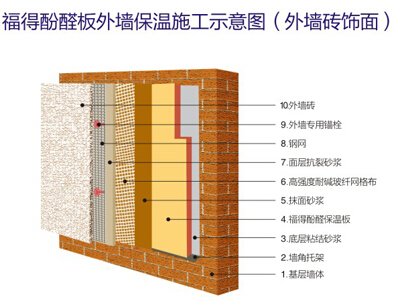
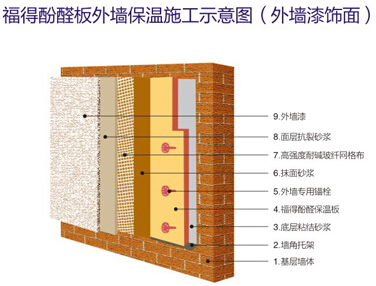
Technical order of FUDE phenolic aldehyde board for external wall insulation Construction technique of this insulation: pasting FUDE phenolic aldehyde clad boards with adhesive mortar and fixing insulation coat with anchor bolts; structuring thin rendering enhanced protective cover with adhesive mortar and compound alkaline resistant mesh; coating for finishing coat, etc. |
Sketch map of FUDE phenolic aldehyde insulating construction for external wall (external wall brick finishing) |
FUDE phenolic aldehyde insulating construction process flow for external wall Process wall grass roots→draw control line→prepare adhesive→paste phenolic aldehyde clad board→anchoring by anchor bolt→fill in slab joints, leveling→prepare surface mortar→paste surface mortar→press in alkaline resistant mesh→paste surface mortar→check and accept. | |
■ Process wall grass roots The wall shall be cleaned without accretions such as floating ash and oil slick which would affect adhesion. After grassroots wall is checked and qualified, paste 1:3 cement mortar and level. Rendering of leveling blanket shall be carried out in layer and thickness of each rendering shall not be over 10mm. Check with 2m inspection ruler, largest deviation shall be smaller than 4mm and out-of-tolerance place shall be chiseled, mended and flatted. |
Sketch map of FUDE phenolic aldehyde insulating construction for external wall (external wall paint finishing) |
| ■ Draw control line According to technology requirements on architecture façade design and external wall insulation system, horizontal, vertical lines, lines for dilatation joints and decorative seam shall be drawn out. Vertical reference control line shall be hung out at internal and external corners on the external walls of architecture and other necessary positions while horizontal lines could be hung out at suitable positions of each floor for controlling the perpendicularity and planeness when pasting phenolic aldehyde boards. | |
■ Prepare special interface adhesive | |
| ■ Paste FUDE phenolic aldehyde board Before construction of FUDE phenolic aldehyde board, cutting plan shall be drawn as design requires, ascertaining specification and quantity of irregular slabs, drawing location plan of blocks on grass root with ink line. Professional cutting tools are adopted to cut phenolic aldehyde boards on site, but be careful, the cut must be perpendicular to the board. Full adhesive method: firstly, paste special interface adhesive for 50mm wide on the circumference of phenolic aldehyde board, then gradually thicken from edge to the center until the whole board is pasted with the thickest part of 10mm. Then, immediately paste the phenolic aldehyde board on the wall, sliding until in position. When pasting, you shall softly and even press the board and level with 2m guiding rule. It is strictly forbidden to knock at the board while pasting, so as to avoid cohesive mortar from falling off, reducing cohesive area and affecting cohesive strength, ensuring that its perpendicularity and flatness meeting with requirements. Adhesive shall be timely cleaned up after pasting a board. No gap shall exist between two boards and slab joints over 5mm shall be filled in with insulating boards of same thickness. Height difference of edge joints shall not be larger than 1mm. Edge-bulge-method: paste special interface adhesive on four sides of phenolic aldehyde board with width of 50mm and thickness of 8 to 10mm, arrange 6 points even in the center of board, diameter of which shall be 100mm, thickness be 10 to 12mm, center to center spacing be around 200mm. Practices on pasting construction are the same with full adhesive method with pasting area larger than 50% of the board area. Phenolic aldehyde board shall be pasted bottom-up and horizontally. Phenolic aldehyde boards in up and down rows had better to be mismatched with mismatching length equal to 1/2 of the board length. Maximal mismatching length shall not be smaller than 200mm. At wall corners, they shall be interlaced and interlocked. Insulating boards on the four corners of door, window and hole shall be complete boards rather than splicing. Distances between seam and four corners of hole shall be larger than or equal to 200mm. |
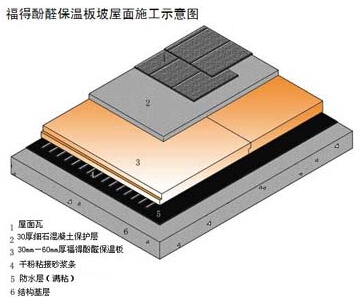
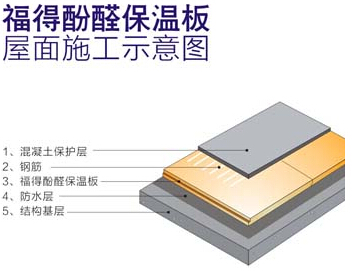
Sketch map of FUDE phenolic aldehyde insulating construction for slope roof |
■ Install anchor bolt Installation of anchor bolt could only be carried out 8h after pasting of phenolic aldehyde plate. After pasting phenolic aldehyde plate tightly, drill holes with impact drill and then install anchor bolts as design requires. Anchor bolts for external walls shall be fixed into grassroots wall 50mm while anchor bolts for internal walls shall be fixed into 35mm. Distance between anchor bolts shall not be larger than 300mm while distance to edge of grassroots wall shall not be smaller than 60mm. Anchor bolts shall be even distributed on single plate and at least 5 anchor bolts can be found on each plate. | |
■ Protective cover construction After phenolic aldehyde board installation is accomplished, checked and accepted, carry out construction of anti-cracking mortar protective cover. Rendering of protective cover shall be constructed by method of pasting the bottom and the surface. According to design requirement, it is needed to paste a layer of bottom anti-cracking mortar which shall be larger than a mesh or (steel wire mesh) on the surface of phenolic aldehyde board which is pasted on mesh (or steel wire mesh) with changed thickness of about 3mm (or 6mm). Immediately lay the mesh cloth (or steel wire mesh) on it with the bend face facing inward, then screed from the center to four sides with spatula, causing it to cling on the surface of bottom anti-cracking mortar tightly. Before coagulation of bottom anti-cracking mortar, have its surface covered. It is forbidden to ceaselessly rub surface mortar to avoid formation of hollowing. Breaks of mortar rendering construction shall be at natural breaks on dilatation joints, internal and external corners, and cantilever platform for the convenience of overlapping of subsequent construction. If breaks are needed on subsequent walls, surface mortar shall not completely cover laid mesh cloth (or steel wire mesh), requiring to be in sidestep slope stubble with mesh cloth (or steel wire mesh), bottom mortar with leaving distance larger than or equal to 150mm to avoid flatness of mesh cloth (or steel wire mesh) overlapping position surpassing deviation. Internal and external corners of polymer mortar compound phenolic aldehyde board shall be hung and pasted with alkaline resistant glass fiber cloth and implement interleaving, binding and overlapping, (width for interleaving, binding and overlapping of each side shall not be smaller than 200mm); you can also firstly, hang a piece of alkaline resistant mesh cloth, then add a piece of alkaline resistant mesh cloth again (width for each side shall not be smaller than 200mm). Hanging of alkaline resistant mesh cloth on internal and external corners is the same. Alkaline resistant mesh cloth which is over 200mm broad shall be used to bind the four directions of holes on door and window, extending 100m wide into the hole and 600×200mm alkaline resistant glass fiber clothes shall be pasted on four corners with pasting angle of 45°. Method for attaching alkaline resistant mesh cloth on holes of door and window is the same with above one. Alkaline resistant glass fiber cloth hung on phenolic aldehyde board shall be at the edge between nude temperature wall surface and non-insulation surface. Internal mesh cloth shall extend 100mm, overlapping non-insulation surface. Dividing joint processing: draw out the position of diving joint on insulating board according to design requirements, and dividing strip shall be put into when carrying out rendering process and taken out when mortar primarily concreted, finish hemming-stitch. Dividing joints shall be water-proof according to design requirement; provided that no requirements in design, water-proof in-seam sealant for architecture shall be used for filleting. To improve shock resistance capacity of ground floor, a layer of mesh cloth shall be added on the surface of external wall of ground floor. |
Construction of polymer mortar compound phenolic aldehyde board protective cover |